
Blogs · Blogs
Trust and Check Starts at the Mailbox: How the New EU Customs Code Is Changing the Work of Customs Declarants
The new EU Customs Code is changing the way customs agencies work. Data, transparency, and traceability are becoming increasingly critical. But the biggest change does not start in customs software. It starts in the mailbox.
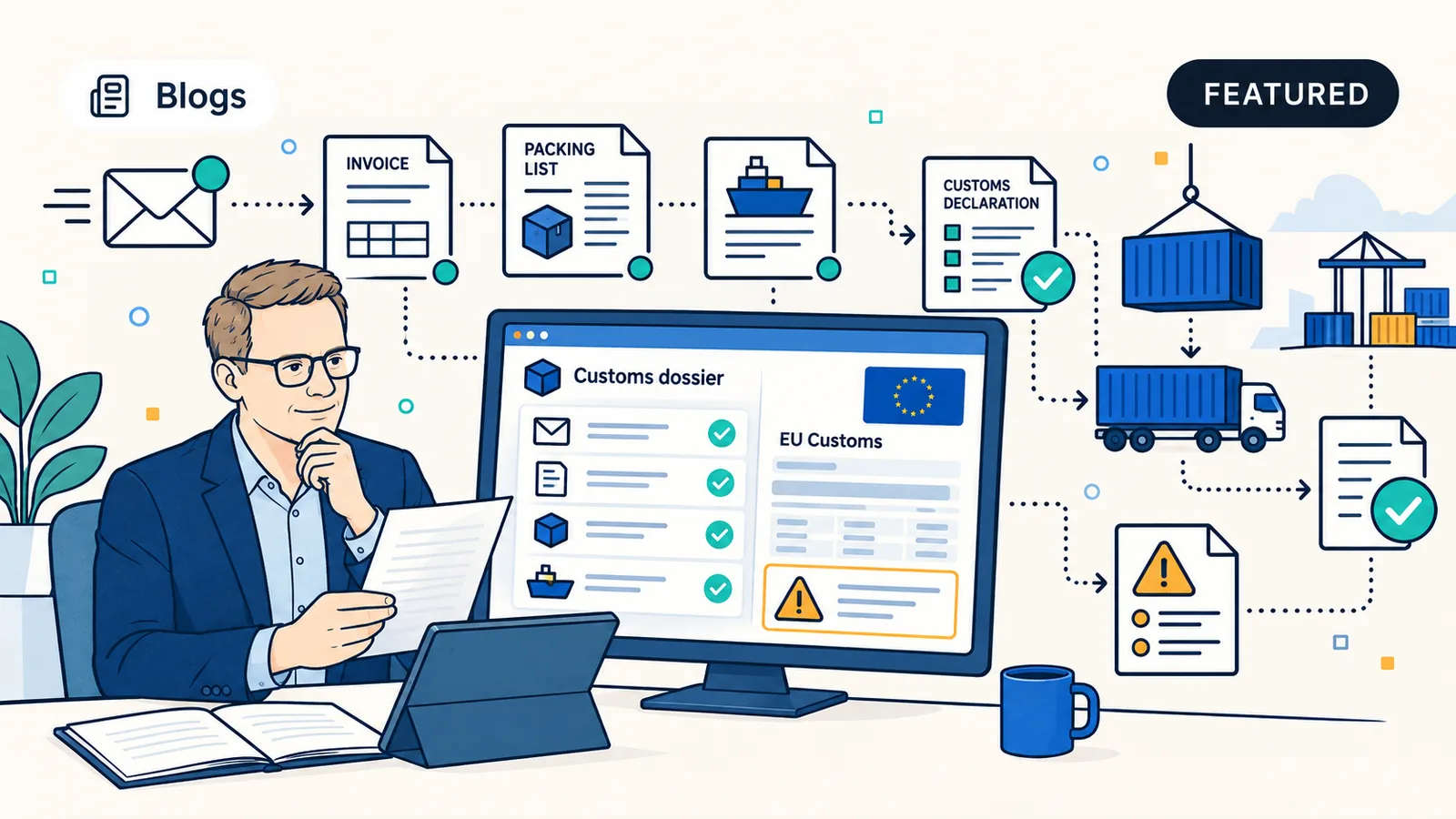
On 20 September 2026, the new Union Customs Code entered into force. A major milestone for the European customs landscape, but on the operational floor, it likely went largely unnoticed.
Mailboxes continued to fill up with invoices, packing lists, and instructions. Customs declarants gathered information from various documents, verified data, and then entered it into their customs software.
Just like the day before.
Yet the sector stands on the brink of fundamental change. Over the coming years, the focus is shifting from submitting declarations to demonstrably controlling the underlying data.
And that demands a different way of working.
From customs declarations to reliable data
The EU customs reform is being rolled out in phases. The most significant changes will become visible from 2027 onwards, while the new EU Customs Data Hub will be further deployed between 2028 and 2034.
Three developments are crucial for customs agencies and brokers.
1. Data becomes more important than the declaration itself
With the introduction of the Customs Data Hub, a central environment is created where trade data is made available. Information provided earlier in the supply chain can be reused.
The traditional customs declaration will not disappear overnight, but the underlying premise is changing: less fragmented data exchange and more reliance on reliable, readily available data.
2. Roles and liabilities are shifting
The distinction between importers, exporters, and representatives is being redefined. This can have significant consequences, especially for indirect representatives.
A customs broker acting indirectly on behalf of a non-EU principal could soon be classified as the importer itself. This significantly increases responsibilities and potential liabilities.
3. Trust and Check introduces a new standard
Alongside the existing AEO status, a new status is being introduced for companies that demonstrably control their customs processes and data: Trust and Check.
Companies meeting the requirements can benefit from further simplifications and more favorable treatment within risk management.
In return, there is a clear requirement: continuous transparency and the ability for customs authorities to access data in near real-time.
Trust and Check requires more than sound procedures
Many customs agencies already hold an AEO status. They have set up their administrative workflows, defined internal controls, and trained their staff.
However, Trust and Check goes a step further.
It is becoming increasingly important not only to demonstrate that a process is well-structured, but also why a specific decision was made within a file.
Consider questions such as:
-
Which invoice was used to establish the customs value?
-
Which Incoterm and valuation adjustments were applied?
-
What proof of origin supports the selected preferential tariff?
-
Which retroactive corrections were received and processed?
-
Who reviewed and approved an anomaly or discrepancy?
In many organizations, those answers can be found. It just takes a substantial amount of time.
The information is scattered across inboxes, documents, customs software, and sometimes simply stored in the memory of an experienced customs specialist.
In my view, that is one of the biggest challenges for the coming years: not a lack of expertise, but a lack of structure around that expertise.
A declarant's real work is not manual retyping
Imagine a Friday afternoon.
A client sends sixty invoices combined into a single PDF file. Several documents show differing Incoterms. For one line item, the commodity code does not match previously submitted data.
Meanwhile, a driver is waiting, a container needs scanning, and the customer is asking when the goods will be released.
Come Monday morning, a revised invoice arrives for a declaration that was already accepted on Friday.
This is the day-to-day reality for many customs operations.
And this is precisely where the true value of a customs declarant becomes clear.
Not in manually retyping line items, tracking down files, or managing open queries in an email thread.
Rather, in evaluating discrepancies, applying customs expertise, and making the right decisions.
That is also why I do not believe AI will simply replace declarants.
Instead, I expect AI to reshape the role of the declarant, creating more time for the specialized expertise that truly adds value.
Tomorrow's declarant works differently
Looking ahead over the coming years, I see a clear shift.
Less time spent on:
-
Searching for data in emails and attachments.
-
Chasing missing documents.
-
Manually copying invoice lines.
-
Tracking open action items and post-clearance corrections.
More time spent on:
-
Assessing customs value, origin, and classification.
-
Investigating conflicting data.
-
Handling exceptions and compliance risks.
-
Substantiating and documenting decisions.
For customs brokers and agencies, this also presents a clear business opportunity.
Experienced declarants are scarce, and margins on routine declaration volumes face downward price pressure. By streamlining the preparatory work, teams can handle higher volumes without an equivalent increase in workload.
At the same time, file quality and compliance become far easier to prove.
Why change begins at the mailbox
At DocHeart, we speak regularly with customs brokers about automation. What stands out is that the biggest bottlenecks often arise before anyone ever opens customs software.
An order arrives via email. The attachments contain invoices, packing lists, and transport documents. Sometimes information is missing or files contradict each other.
Only when everything is complete and verified can the declaration be prepared.
Many organizations attempt to improve this process by automating data entry directly into their customs software.
That helps, but it does not solve the core issue.
Because if the information entering that step remains unstructured, you are only automating a minor fraction of the workload.
That is why at DocHeart we believe in organizing first, then automating.
We build a layer between the mailbox and existing customs software.
Incoming orders and documents are unified into a single file. Data is extracted automatically and linked back to its original source.
Missing data and discrepancies are surfaced instantly. For instance, if an invoice indicates EXW while the shipping instructions state CIF, the system should not resolve that quietly on its own.
It must flag the anomaly for the declarant to review.
The declarant assesses, decides, and remains in full control.
And because data, document versions, and decisions stay linked together, an audit-ready, traceable file is generated automatically.
This is not only more efficient: it directly aligns with the future direction of European customs legislation.
Five steps customs agencies can take today
The complete reform will take years to implement. Fortunately, that does not mean organizations should wait.
In fact, many improvements deliver value today, irrespective of the new regulations.
1. Map out the preparatory work
Track for a week how much time your team spends searching, gathering, and copying data. Compare that to the time actually spent on substantive customs assessment.
2. Take a critical look at direct vs. indirect representation
Trust and Check may offer valuable advantages, but indirect representation also carries additional liabilities. Determine which clients and operations fit your agency's risk profile.
3. Start with one fully traceable workflow
Select one high-volume customer or a specific transit flow. Ensure that every step, from the initial email to the final declaration and any subsequent corrections, is completely traceable.
4. Structure and capture customer knowledge
Commodity code databases, agreed guidelines, exceptions, and compliance checks should not rely exclusively on the memory of individual specialists.
5. Monitor upcoming regulatory implementation
The implementing regulations for Trust and Check and the Customs Data Hub are still being drafted. Stay informed on these updates and assess early on what they mean for your business.
The future of customs does not begin in 2034
The EU customs reform revolves around data, but the real transformation happens in daily operations.
In a few years, it will be critical for customs brokers not only to submit accurate declarations, but also to prove how each figure and decision was established.
That requires reliable data, well-organized processes, and domain expertise.
I am convinced that the combination of all three will make the real difference.
AI can take over much of the preparatory groundwork. But judgment, accountability, and expertise remain firmly with the customs declarant.
And the sooner we structure that workflow properly, the better prepared we are for what lies ahead.
Curious how much time your team spends preparing customs declarations?
Start by measuring a single week. I would be happy to review the findings with you and discuss where the biggest opportunities lie, even if you have already experimented with AI without getting the desired results.
Sources: Regulation (EU) 2026/2108; Council of the European Union; European Commission (DG TAXUD), EU Customs Reform; analyses by EY, Ashurst Perkins Coie, Matheson, and evofenedex. Implementing regulations are still under development.