
Blogs · Solution & Industry Insights
Why AI in logistics does not start with fewer people
On the lesson behind companies rehiring staff after hasty AI decisions
The recent MT/Sprout article about companies rehiring staff after AI-driven layoffs touches on an important point for me. Not because it proves AI does not work. On the contrary. AI will play a major role in how organizations structure their work. But it does show what happens when AI is implemented too simplistically: as a direct replacement for people, without sufficient understanding of what those people actually do.
For us at DocHeart, that is precisely why we deliberately choose a different product strategy. We do not believe the first question should be how many people you can replace with AI. The first question is which work you can organize better, what knowledge is embedded within it, and where human control remains necessary. In logistics especially, this distinction is crucial.
Work is more than just a task
From the outside, much operational work looks simpler than it actually is. An employee reads a document, extracts data, enters something into a system, or verifies a file. When phrased like that, it seems like an obvious candidate for automation. But that only describes the visible action, not the actual judgment behind it.
An experienced employee recognizes the customer, understands the context, knows which documents belong together, and spots when information does not quite add up. They know which exceptions are common, which customer agreements were never formally recorded, and which signals matter before releasing a file. That knowledge is often built over years of experience, conversations, mistakes, rework, and hands-on coordination with customers and colleagues.
You cannot easily replace that with a tool. In fact, if you remove those people from the process too quickly, you often strip away the exact knowledge needed for AI to function properly.
Why this lesson is especially critical in logistics
Logistics is an environment where speed, quality, and control must continuously align. Customers expect fast processing. Compliance demands accuracy. Systems require structured data. Operations need clear oversight. Meanwhile, documents, instructions, and exceptions often arrive at different times and across various channels.
That is why simple logic like 'AI reads documents, so fewer people are needed' fails. The question is not just whether AI can read a document. The question is whether AI has enough context to help determine what should happen with that document. Is the file complete? Do documents contradict each other? Does the value make sense based on historical data or master data? Does an employee need to review this first?
The average file is rarely the problem. Operational quality is defined by how exceptions are handled. That is precisely where experience, judgment, and oversight are indispensable.
Our product strategy is built around collaboration
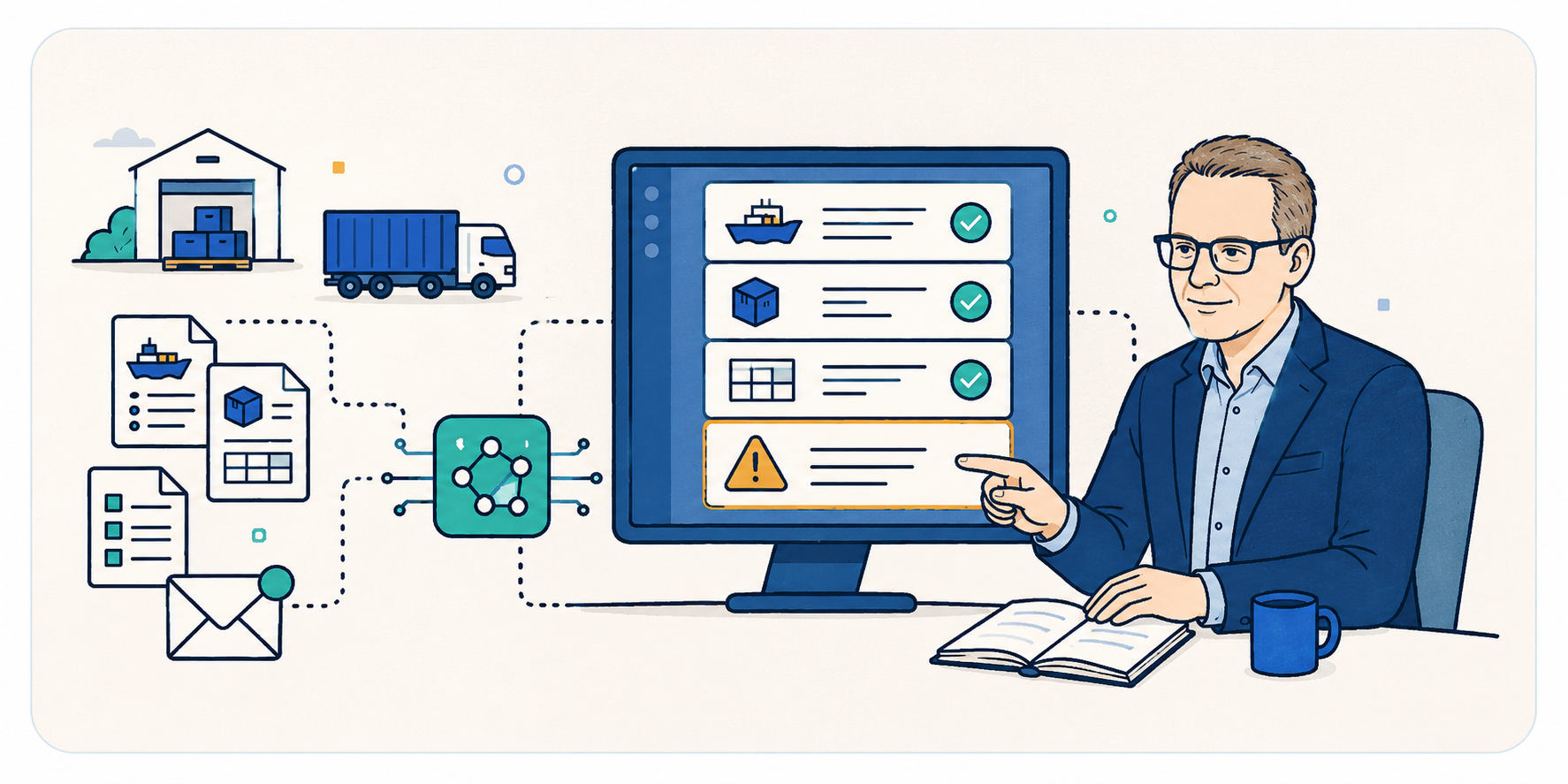
That is why we are not building DocHeart to simply remove humans from the process. We are building a workbench where AI handles the preparatory work, allowing team members to focus their attention where it adds real value. AI can assemble files, recognize documents, prepare data, flag missing information, and surface risks. The employee reviews, corrects, and approves when necessary.
That might sound less sensational than full automation. But in complex workflows, it is often the more mature path. The value is not just in eliminating keystrokes. The value lies in less searching, less rework, less hidden knowledge, and greater control over exceptions. These are the factors that drain operational capacity every day, yet rarely show up on a dashboard.
AI does not replace judgment. AI organizes the work around that judgment more effectively.
Human knowledge must become explicit
An important takeaway from current AI debates is that institutional knowledge does not automatically exist inside a model. In logistics, this is perhaps even truer than in other industries. Much of the knowledge is implicit. A planner knows when a route is fragile. A customs declarant knows which documents trigger disputes. A customer service representative knows when a client's written instructions do not quite match what they actually mean.
The opportunity with AI is not to ignore that knowledge, but to make it explicit step by step: by capturing corrections, recognizing recurring exceptions, configuring checks, and building customer profiles, review workflows, and playbooks. This reduces reliance on isolated individual experience without pretending that experience is no longer needed.
The real lesson
Companies rehiring staff after over-optimistic AI initiatives demonstrate that there is a big difference between task automation and understanding the work. You can automate a task technically and still degrade the overall process if you strip out context, exceptions, and human review.
For logistics organizations, that is perhaps the most vital lesson. Effective AI does not start with reducing headcount; it starts with organizing work better. Organizations that achieve this will not only operate faster. They will also be better equipped to explain what is happening, where risks lie, and why their processes are dependable.
That is our direction. Not AI as a replacement for the logistics professional, but AI as a controlled operational layer that connects experience, context, and technology.